
Innovation is what the doctor said
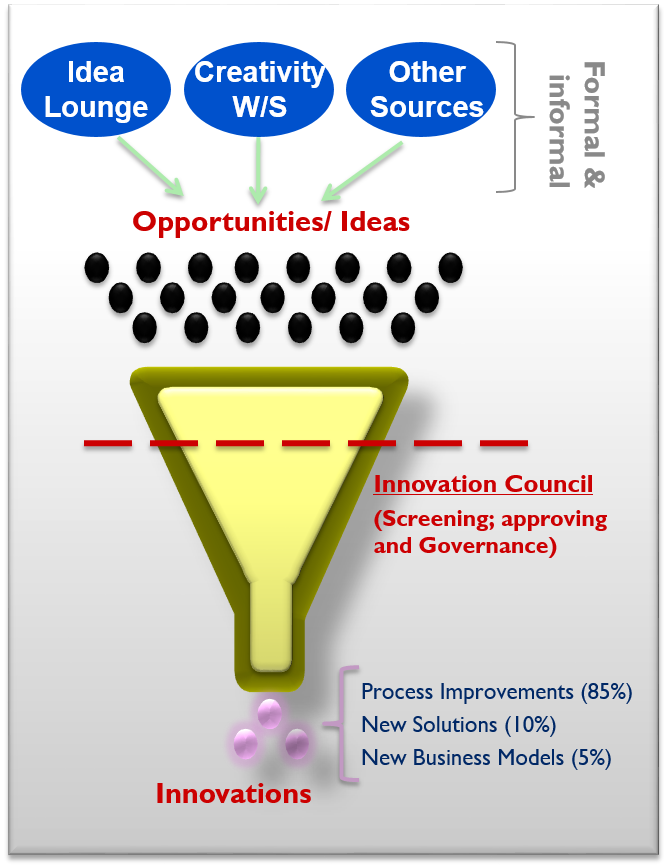
Innovation: you cannot open a magazine or scan a web forum these days without stumbling upon a mention of innovation. Customers, business leaders and oracles together demand innovation focus or attention. In spite of the frequency and volume of mentions, confusion remains on what an entrepreneur or leader can do, especially without the budget of a pharmaceutical conglomerate.
Innovation can be defined as bringing something new (idea, product, device) or / and the new object itself. Invention can be a category of innovation, but the aggregation of existing parts into a new construct is innovation too. In many cases, business leaders are seeking more than just one innovative artifact, and are trying to create an innovation process, from ideation to deployment, that can provide continuous new ideas or products for a business or organization.
Competitive differentiation would suffice to justify innovation investments, for leveling of the gap against another competitor (competitive equalizer) or for creating this very gap against less fortunate competitors. Samsung devices, and then others jumping into the fray. Innovation can be the result of a structured, methodical research with labs and equipment, but can also be the outcome of informal initiatives taken by employees, customers providing feedback or just a casual opportunity for a change. This paper might help preparing and managing innovation without breaking the bank.
Innovation as competitive differentiator
The perception of being an innovative provider is a fundamental builder of brand equity, as customers want to acquire one of the latest versions, offering something others do not, or catching up rapidly when competitors launch new features.
But there is a deeper rationale, in particular in the business to business space (less sensitive to passing fades) to buying from a provider always at the top of the game, and taking advantage of even tiny changes to keep a step ahead of the competition. Even at the cost of trying things which will not take hold (remember the multi-screen plasma terminal?), being at the top of the game is not just a mindset but often an absolute requirement to stay in business. An early cloud adopter in the software industry will take a risk of seeing products not being adopted fast enough to match revenue and profitability targets. Once the market is picking up, they will reap the brand and market share benefits offering a novel and compelling solution which has been field tested already, at an affordable price. Looking at competitive differentiation as an innovation focus means defining a few precise performance indicators, and setting up a target value for them or at least an acceptable range of improvement.
Let’s imagine a retailer seeking to optimize its Inventory Turnover which is the cost of goods sold by the Average Inventory. Some employees might work on finding ways to reduce the holding costs of the inventory, while others focus on moving things faster off the shelves. The combination of both will have an exponential impact of the profitability and the Turnover. Letting each team work on their chosen scope generates the deepest analysis of the organization’s operational process, while having someone facilitates the process allows picking disparate elements to make them work in tandem.
It starts at home
A first step in establishing a drive for innovative ideas is to set up overall goals for excellence. There is a need for everybody to perceive a higher achievement as a company goal, where their possible contribution becomes a step on the way. What motivates someone to find out a streamlined way of doing things, or to create a new feature for an existing product, includes that fact that the business will run better (higher performance from process optimization) or increase revenue (through incremental sales). In both cases, a goal of higher order (the “Greater Good”) fuels the search for a new way.
People who devote time, energy and passion into hours of deep thinking, trial and error before they come up with an innovation nugget expect their find to bring them recognition and other rewards. Although such recognition can happen on a case by case basis, the institutionalization of the practice will create a tangible, trivial reward mechanism for those coming up with usable ideas.
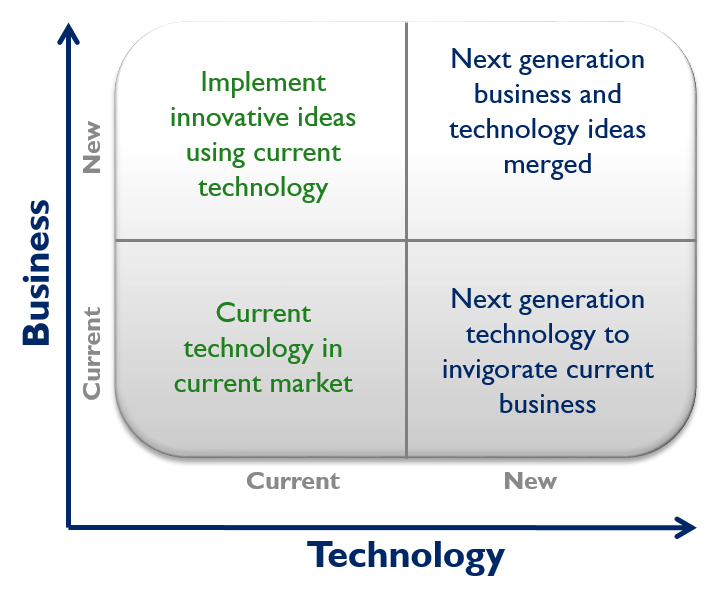
Just like a proposal coming out of a Research and Development lab, each idea needs to be assessed against a rigorous and repeatable process, scoring the viability of the idea against its feasibility, potential business / net value, the length and complexity of its potential deployment, along with its alignment with the long term and shorter focused strategic goals for the company. This example describes a simple 2×2 chart to evaluate ideas against a standard Business / Technology mapping.
Enterprise Innovation Framework
Building an enterprise level Innovation framework makes innovation a common, trivialized (in a good way) process. With the reward mechanism in place, ideas will soon start to flow. A hidden gem into this framework is the capacity to bring teams from various origins together in a collaborative manner, naturally. It can sound strange to seek external help to achieve internal innovation, but a healthy dose of fresh thinking can actually break conventional lethargy and create new paths to explore.
An unused source for such endeavors is the network of partners, providers and alliances that most businesses have built over time. Each of the external partners have their own business, views and idiosyncrasies, just like we all do. How about inviting them in, and instead of forcing them to think along our own terms, giving them a carte blanche to rethink anything in their own way? It might create some innovative white noise, but could also generate some precious nuggets, which is just what you need.
How much should an organization spend on innovation? How to evaluate the returns or monetization of innovative ideas? There is no secret sauce that fits all organizations and situations, unfortunately. Any innovation effort should be driven by the capacity of an organization to invest, its idea of a return and the clout of its management to stay the course or pull the plug. Innovation carries risks too, the highest being distracting key personnel from their primary mission.
Since the investment on innovation is typically over time, Net Present Value formulae can summarize the Focused NPV for the idea itself and its short term value and impact to the P&L; a second one is the present value of the Innovation effort across the organization. The core return on idea value can be calculated with the following:

This formula assumes a 3 years return on the idea’s investments, and the sunk costs are a combination of the ideation maturation costs (Ci) and the cost of executing the idea (Cm), including any cash flow or investment.
‘The matching formula for defining innovation investments as a discipline is likely better suited for a 5 years charter, with the annual cash value being the combination of direct (revenue, savings) and indirect (e.g.: market position, brand equity) returns. The sunk costs here are reflecting the cost of the process of ideation (Ci) and of managing the portfolio of ideas (Cpi).

A typical Innovation process looks like the graphic below, allowing each idea to be gradually matured into a full scale initiative, with a business unit or executive taking it under its wing to ensure its successful completion in the most appropriate context. This is actually a good thing, and causes sometimes the authors to resent seeing their puppy of an idea being hosted into a new home.
But a part of the innovative culture includes the fact that ideas once they enter the process, have a life of their own, driven solely by the potential value to the organization.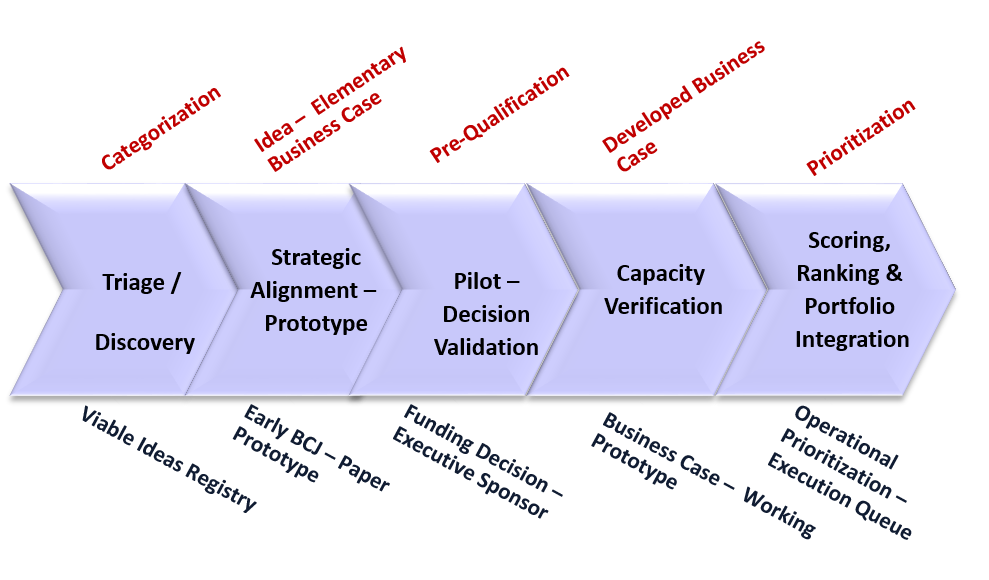
Grouping all ideas and their maturation process into a portfolio construct allows to monitor progress, volume and quality of entries, as well as calculating continuously the value of the entire portfolio and its expected returns.
With limited investments, a large potential of returns, and a natural alignment with the business and strategy, investing in internal innovation no longer seems like throwing money out of the windows. As a strategic tool, it should be measured against its returns and value to the organization, like all investments should be.
Now, let’s go back to the office and create some darn good new ideas…

 Melting the barriers of strategic thinking